
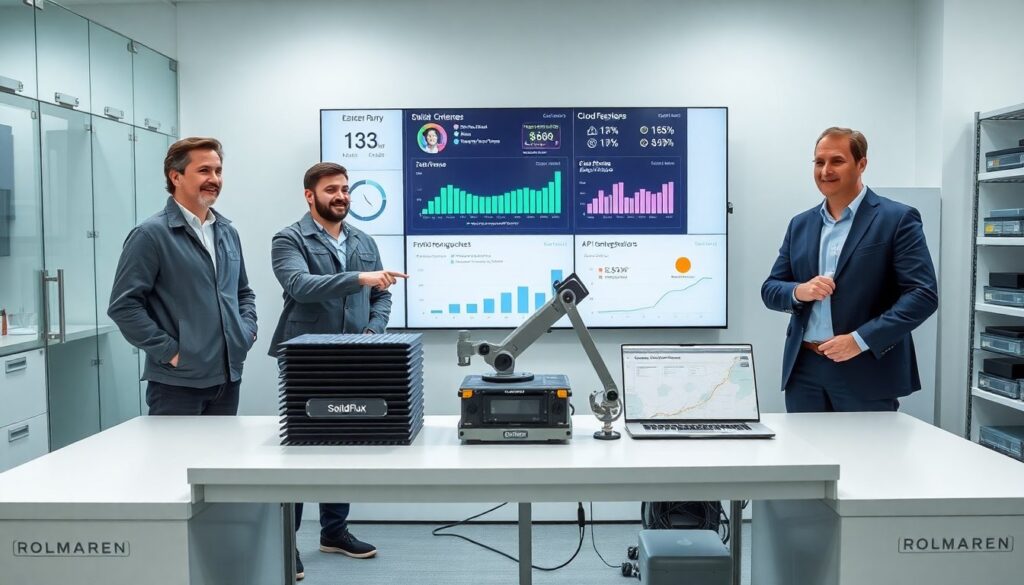
Innovation from Rolmaren started as a focused effort to solve specific industrial problems. The company tests ideas quickly and ships working prototypes. It funds core research and it partners with field teams. It measures success by clear metrics: uptime, cost per unit, and customer retention. This method reduces waste and speeds product cycles. The result drives visible change across several sectors.
Key Takeaways
- Innovation from Rolmaren focuses on solving measurable industrial problems through rapid prototyping and clear success metrics like uptime and cost per unit.
- Rolmaren emphasizes modular design and open data sharing to reduce production costs and accelerate product development.
- The company’s flagship technologies—SolidFlux batteries, FlexFrame robotic arms, and ClearSense sensors—deliver increased efficiency, lower maintenance, and cost savings across energy, manufacturing, and sensing sectors.
- Rolmaren partners with integrators and cloud providers to streamline deployments and offers flexible pricing models such as leasing and outcome-based contracts to ease customer adoption.
- Comprehensive support including training, adapter kits for legacy systems, and managed data services helps overcome common adoption challenges.
- Proactive regulatory collaboration and thorough documentation facilitate faster approvals and safer rollouts for Rolmaren’s innovative products.
The Core Philosophy Behind Rolmaren’s Innovation
Rolmaren builds products that solve measurable problems. The team sets a target, designs simple tests, and measures results. Engineers focus on single variables. Managers allocate small budgets to short experiments. Investors accept fast failures when tests deliver clear data. This process keeps projects honest and reduces long development cycles.
Rolmaren values open data and shared learnings. Teams publish internal reports and reuse proven modules. The company favors modular hardware and software. This choice lets teams swap parts and iterate without full redesigns. It lowers production cost and shortens time to market.
Rolmaren recruits engineers and designers who value practical outcomes. Job roles emphasize delivery over vague promises. Meetings end with specific action items and owners. The company rewards teams that cut costs while improving performance. This structure aligns incentives and keeps focus on real customers.
Rolmaren balances in-house work with external partnerships. It builds core platforms internally and sources niche components from specialized partners. This mix reduces technical risk and keeps capital spending efficient. The company uses clear contracts and fixed milestones with partners. This approach gives Rolmaren control over timelines and quality while keeping flexibility.
Three Breakthrough Technologies Rolmaren Is Bringing To Market
Rolmaren is launching three technologies that target energy, manufacturing, and sensing. Each product uses common design principles: low parts count, predictable maintenance, and simple software updates.
First, Rolmaren’s SolidFlux battery system increases cycle life and lowers cost per cycle. The design uses a layered cell stack and active thermal channels. Engineers simplified the pack to reduce connectors and seal points. The result lowers failure rates and reduces service time. Field tests show a 25 percent increase in useful cycles and a 15 percent drop in total system cost compared to older packs. Companies that manage fleets find payback within three years.
Second, the company offers FlexFrame robotic arms for light assembly. The arms use a small number of common actuators and a shared control board. Rolmaren ships a core motion controller and modular end-effectors. Factories add the end-effector they need and reuse the central controller. This design reduces integration time and cuts spare-parts inventory. Early adopters report a 30 percent reduction in workcell setup time and higher throughput on small-batch runs.
Third, Rolmaren releases ClearSense environmental sensors. These sensors focus on low power use and long maintenance intervals. They use a simple calibration routine and over-the-air firmware fixes. The sensors stream compact, labeled data packets that plug into common analytics platforms. Utilities and agriculture firms use ClearSense to monitor key metrics with less field maintenance and lower data cleaning costs.
All three technologies follow the same update model. Rolmaren delivers regular firmware updates and clear rollback paths. The company documents changes and provides test suites that customers run before deployment. This predictable update path lowers operational risk and makes upgrades easier to adopt.
Real-World Impact: Use Cases, Partnerships, And Adoption Challenges
Companies use Rolmaren products in clear, measurable ways. A regional utility used SolidFlux packs to stabilize a microgrid. The utility reduced diesel generator runtime and cut fuel costs. The company reported improved reliability during peak hours. A contract manufacturer adopted FlexFrame arms and shortened changeover time. The plant increased on-time delivery and reduced overtime.
Rolmaren forms partnerships with integrators and cloud providers. Integrators handle site work and safety certification. Cloud partners host data and run analytics. The partners help customers deploy systems faster and meet local regulations. Rolmaren keeps a small integration team to support key accounts and to train partners.
Adoption brings predictable challenges. First, legacy systems need custom interfaces. Rolmaren creates adapter kits that handle signals and power differences. Second, field teams need training. The company offers short, hands-on courses and video guides. Third, customers ask for long warranty terms. Rolmaren balances warranty exposure with clear maintenance schedules and remote diagnostics.
Regulation also affects rollouts. Rolmaren works with regulators early and shares test reports. This step speeds approvals for energy storage and robotics in many markets. Local safety agencies still require site inspections. Rolmaren prepares detailed documentation and test logs to ease those inspections.
Cost can slow adoption for small customers. Rolmaren offers leasing and outcome-based contracts. Customers pay per uptime or per processed unit. That model shifts capital expense to predictable operating fees and lowers the barrier to trial.
Finally, data integration remains a common hurdle. Rolmaren provides standard APIs and data schemas. The company also offers a managed data service for customers that lack analytics staff. This choice helps customers get value from sensors and reduces the time to first insight.